
Quick Answer: What Should Katy Homeowners Maintain Every Season?
Katy homeowners need a season-specific maintenance schedule — not a generic one. Between 51+ inches of annual rainfall, expansive clay soil, Gulf humidity above 75%, and active storm season from June through November, small deferred repairs compound faster here than in most U.S. cities. This home maintenance checklist breaks every critical task by season so nothing gets missed.
Most seasonal home maintenance guides were written for climates with four distinct, predictable seasons. Katy operates on a different calendar: two high-stakes maintenance windows (storm prep in spring and post-storm recovery in fall), a brutal 9-month cooling load that punishes neglected HVAC systems, and a rare-but-catastrophic winter freeze risk that most homeowners don’t plan for — until they’re paying a plumber at 2 a.m.
This checklist is built around that reality. Every section is a standalone reference — you don’t need to read the whole article to act on one season’s tasks.

$10,000–$100,000+The cost range for foundation repair in Texas, according to the Texas Real Estate Commission (TREC). In Katy’s expansive clay soil environment, gutters and drainage are the primary preventive measure — and they’re a routine maintenance item, not a specialty upgrade.
Why Katy Homes Need a Season-Specific Maintenance Schedule
Katy’s combination of clay soil, Gulf humidity, and a 9-month cooling season means the standard national maintenance advice leaves dangerous gaps. The threats here are hyper-local: your foundation is sensitive to rainfall patterns, your HVAC is working twice as hard as one in Phoenix, and your attic reaches 150°F in July.
Here’s the practical reality: the risks in Katy don’t neatly map to “spring cleaning” or “winterizing.” They map to:
- Pre-storm-season preparation (March–May): Drainage, roof, and structural integrity before June’s storm window opens.
- Peak-cooling-season maintenance (June–August): HVAC, attic, and moisture control while the system runs hardest.
- Post-storm-season recovery (September–November): Assess storm damage, repair before winter rain arrives, winterize plumbing.
- Rare-freeze preparation (December–February): Pipe insulation, generator readiness, and the maintenance tasks that are easiest to do in cool weather.
That’s how this home maintenance checklist is organized.
Spring Maintenance Checklist (March–May)
Spring in Katy is pre-storm-season, not post-winter recovery. The priority is drainage, roof integrity, and exterior sealing — every system that will be tested by June through November’s storm window. Complete these tasks before June 1 so your home is structurally sound before peak weather risk begins.
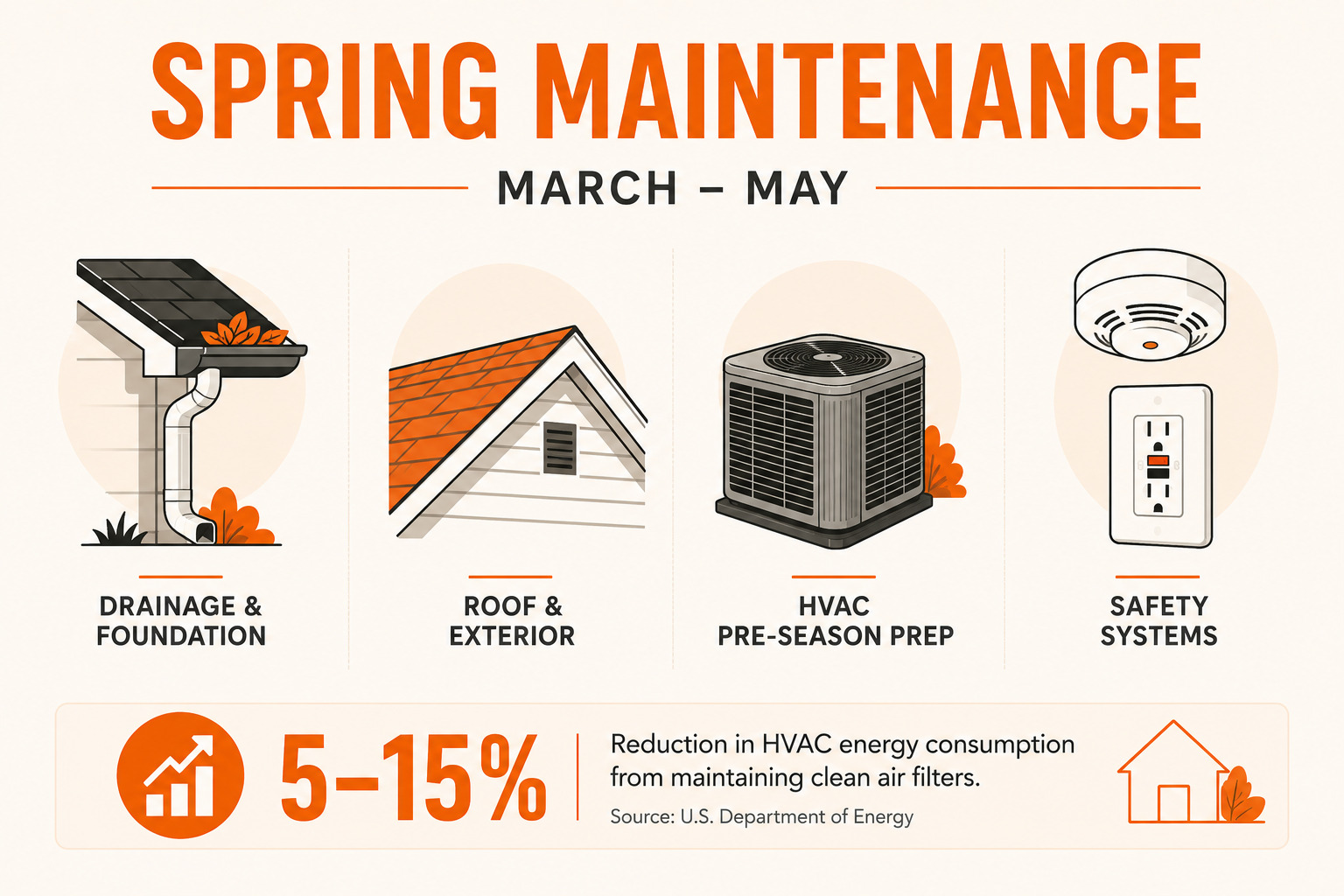
Drainage & Foundation
- Clean gutters and downspouts — remove oak pollen debris and check for sagging sections
- Extend all downspouts at least 6 feet from the foundation
- Walk the perimeter: check that soil grades away from the slab on all sides
- Inspect French drains or yard drainage for blockage after winter rains
- Check window wells and area drains — clear debris before heavy spring rain
Roof & Exterior
- Inspect the roof with binoculars — look for lifted shingles, granule loss, or displaced flashing from winter storms
- Check fascia boards and soffits for wood rot — probe with a screwdriver; if the tip sinks ¼ inch with minimal pressure, rot has taken hold
- Re-caulk around all exterior windows, doors, and penetrations
- Inspect deck ledger boards and joists — Katy’s wet winters accelerate rot in exposed wood
- Pressure-wash siding, driveway, and walkways to remove mold and mildew buildup
HVAC Pre-Season Prep
- Schedule a professional AC tune-up before the first 90°F day — technicians book fast in April and May
- Replace air filters (1-inch pleated: every 30–60 days once cooling season starts)
- Clear at least 2 feet around the outdoor condenser unit
- Rinse condenser fins gently with a garden hose, top-to-bottom
- Flush the condensate drain line with 1 cup of distilled white vinegar
5–15%Reduction in HVAC energy consumption from maintaining clean air filters, per the U.S. Department of Energy. For a Katy home running cooling 9 months a year, that’s a meaningful line item on your electric bill.
Source: U.S. Department of Energy
Safety Systems
- Test every smoke detector and CO detector — press the test button until it sounds
- Check manufacture date on the back of each detector; replace smoke detectors older than 10 years, CO detectors older than 5–7 years
- Test all GFCI outlets in bathrooms, kitchen, garage, and outdoor areas — press “Test,” then “Reset”
- Replace 9-volt batteries in any detector that uses them
Summer Maintenance Checklist (June–August)
Summer in Katy is the highest-stress season for your home. Your HVAC runs almost continuously, attic temperatures reach 150°F, and storm season is active. Summer maintenance is about protecting your cooling system, monitoring for storm damage after every event, and controlling moisture before it turns into mold.
After Every Significant Storm
- Inspect the roof from the ground with binoculars — look for missing or lifted shingles, exposed decking, and displaced ridge caps
- Check for hail damage on AC condenser fins (flattened fins reduce airflow)
- Inspect gutters for dents or separation from the fascia
- Walk the attic within 48 hours — look for daylight, staining on the sheathing, or wet insulation
- Document any storm damage with photos and timestamps for insurance purposes
HVAC Monitoring
- Replace 1-inch filters every 30 days during June–August peak load
- Monitor the condensate drain weekly — a clogged drain can overflow and flood the attic
- Check that the air handler’s secondary drain pan isn’t holding water
- Keep interior thermostat at a consistent temperature — large swings force the compressor to work harder
150°FPeak attic temperature in a Katy home during July, according to local HVAC contractors and building science research. An under-insulated attic at this temperature radiates heat directly into living space, pushing your cooling system past its rated capacity. The EPA recommends R-38 to R-60 for Climate Zone 2 — many Katy homes fall short of R-38.
Source: U.S. EPA ENERGY STAR
Moisture & Mold Prevention
- Inspect bathroom caulk lines — pink or gray staining indicates mold growth behind the surface layer
- Run bathroom exhaust fans during and for 20 minutes after every shower
- Check grout in showers and on bathroom floors — tap tiles with a coin; a hollow sound means the bond has failed and moisture is migrating beneath
- Inspect window seals from inside — condensation between panes means the seal is broken and should be replaced before humidity season peaks
Plumbing
- Check under sinks for slow drips — humidity accelerates cabinet floor rot in Katy homes
- Run the food coloring test on every toilet: add food coloring to the tank, don’t flush, check the bowl after 15 minutes — color means the flapper is leaking
- Inspect outdoor hose bibs for drips — a running outdoor faucet wastes thousands of gallons over a Katy summer
200 gallons/dayWater wasted by a running toilet, according to the U.S. EPA WaterSense program. A $10 flapper from any hardware store fixes most cases in under 20 minutes.
Source: U.S. EPA WaterSense
Fall Maintenance Checklist (September–November)
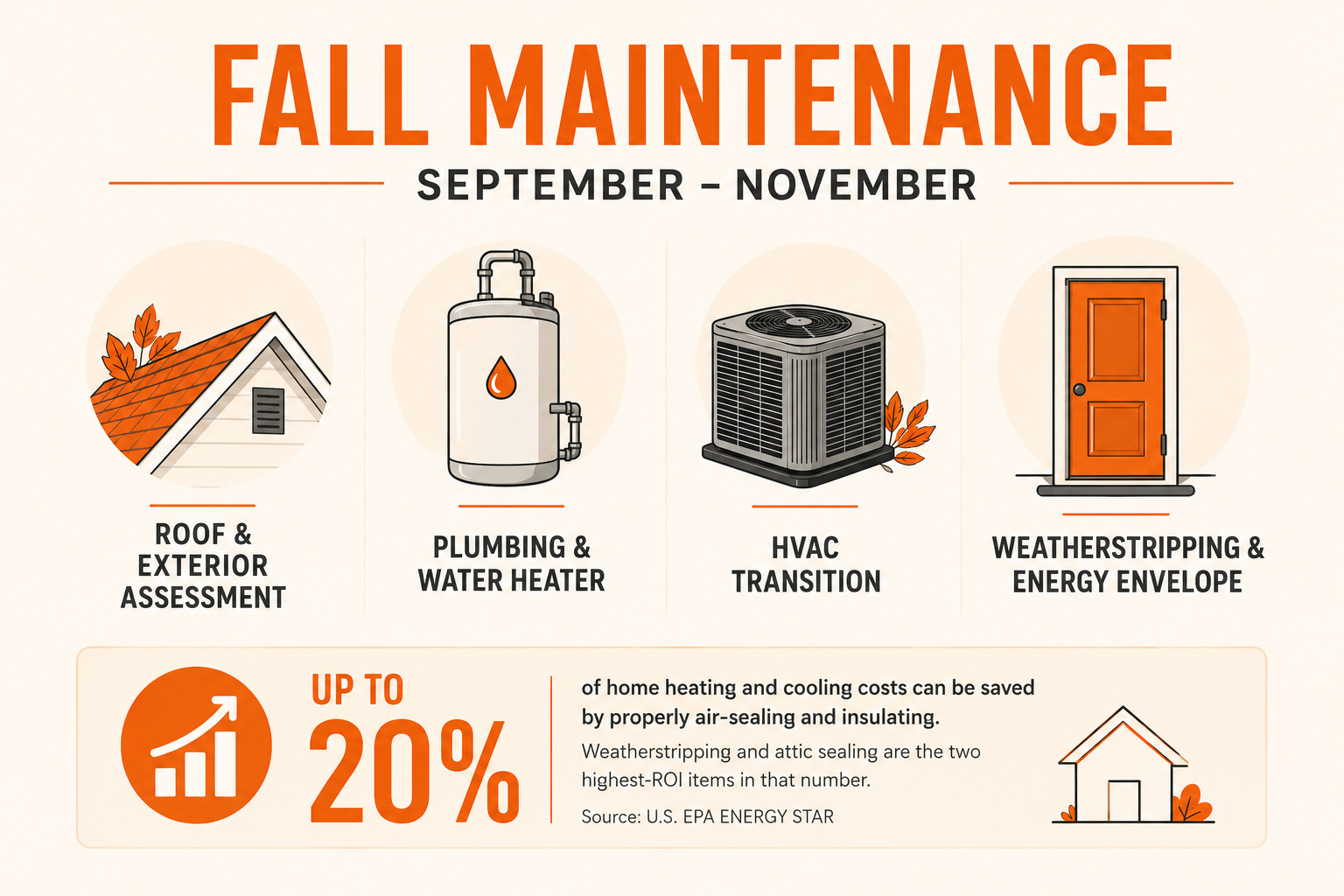
Fall in Katy is not “winterizing” the way northern homeowners understand it. It’s storm-season recovery and pre-winter rain preparation. The goal is to assess accumulated summer and storm damage, repair it before the wet November–January rainy season begins, and button up anything that could worsen over winter.
Original insight: Most national home maintenance guides treat fall as “prepare for cold.” In Katy, fall is actually your second pre-rain-season window. November through January bring sustained rainfall that will exploit every unrepaired drainage gap, unsealed caulk joint, and compromised roof shingle left over from storm season. If you only do serious maintenance twice a year, make it April and October.
Post-Storm-Season Roof & Exterior Assessment
- Hire a licensed roofer for a professional inspection if the roof is over 12 years old or took any confirmed hail this season
- Replace missing or cracked caulk around all exterior penetrations — including HVAC line-set penetrations, which are frequently missed
- Repaint or re-prime any bare wood exposed by chipped paint — bare wood in Katy’s fall humidity absorbs moisture fast
- Clean gutters again after the fall oak leaf drop (typically October–November)
- Verify downspout extensions are still in place and unobstructed
Plumbing & Water Heater
- Flush the water heater tank — connect a garden hose to the drain valve, drain fully, then flush with cold supply to clear sediment
- Inspect the anode rod — replace if less than ½ inch of core wire remains
- Locate and tag your main water shut-off valve; confirm it turns fully in both directions
- Insulate exposed pipes in garages, attic, and exterior walls before December
HVAC Transition
- Replace air filters as the cooling season winds down — a dirty filter going into the off-season collects mold in the humid air handler cabinet
- If you have a gas furnace, have it inspected before first use — carbon monoxide leaks from cracked heat exchangers are a real risk after a furnace sits unused for months
- Test heating mode in October before you actually need it
Weatherstripping & Energy Envelope
- Check door sweeps and compression seals on all exterior doors — run your hand along the bottom on a mild day; any airflow indicates failure
- Inspect attic hatch insulation and weatherstripping — attic hatches are among the worst thermal bypasses in Katy homes
- Replace foam tape weatherstripping (lifespan: 1–2 years) on any window or door that was last sealed more than 18 months ago
Up to 20%of home heating and cooling costs can be saved by properly air-sealing and insulating, according to the U.S. EPA’s ENERGY STAR program. Weatherstripping and attic sealing are the two highest-ROI items in that number.
Source: U.S. EPA ENERGY STAR
Winter Maintenance Checklist (December–February)
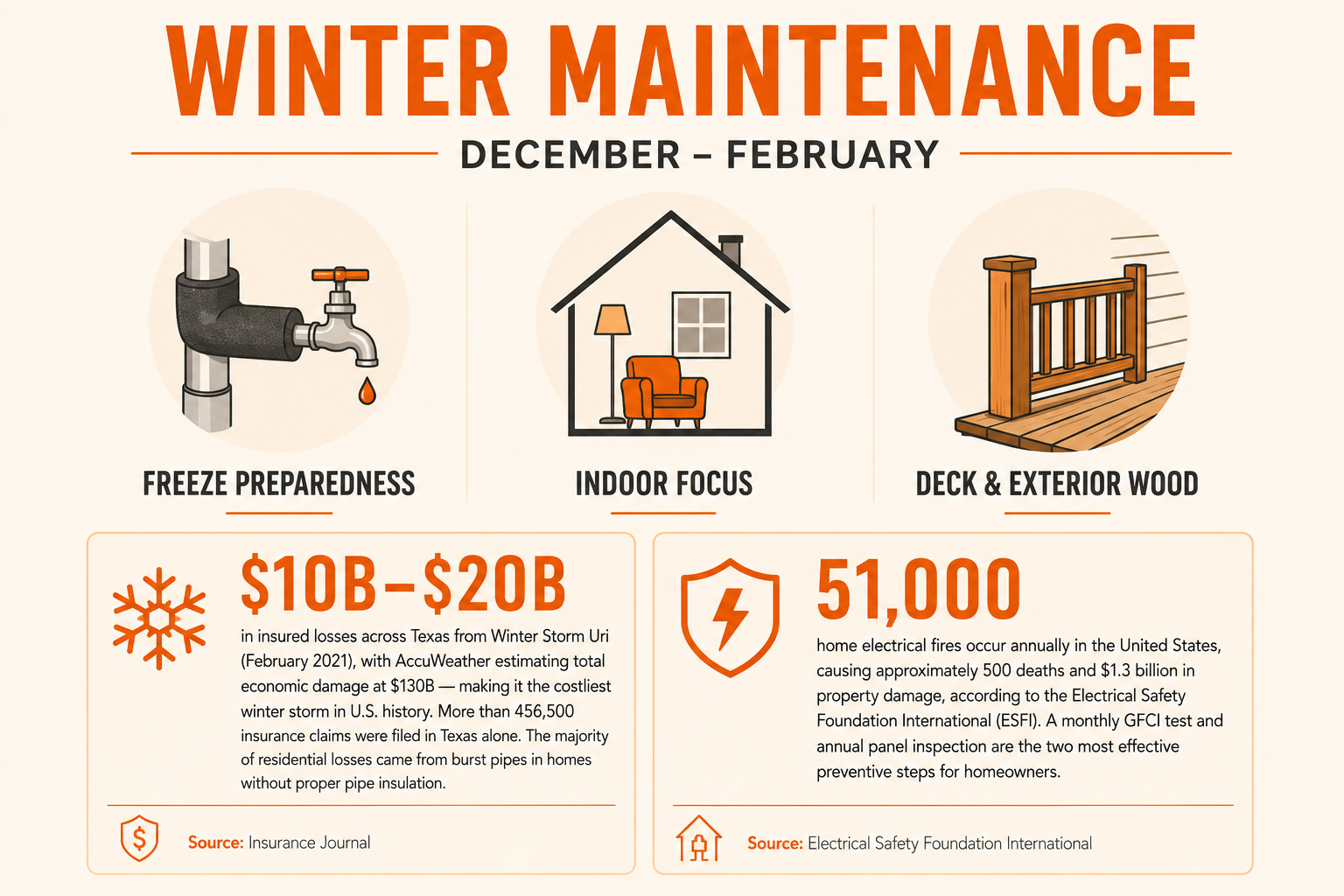
Katy’s winters are mild most years — but the rare hard freeze (like February 2021’s Winter Storm Uri) can burst pipes, overwhelm drainage, and expose every deferred maintenance item at once. Winter is the lowest-risk season for most tasks, which makes it the best time to do slower, indoor-focused maintenance before spring’s high-stakes window opens.
Freeze Preparedness (Every Year)
- Know where your main water shut-off valve is — commit it to memory before you need it at 2 a.m.
- Wrap exposed pipes in garage, attic, and crawl space with foam pipe insulation
- Disconnect and drain garden hoses — leaving them connected can trap water and burst the bib
- Cover outdoor faucets with an insulated faucet cover (available at any hardware store, under $5)
- If temperatures will drop below 20°F, let a slow drip run from faucets on exterior walls
- Have a portable generator or backup heating plan ready — not as a luxury item, as a necessity after Uri
$10B–$20Bin insured losses across Texas from Winter Storm Uri (February 2021), with AccuWeather estimating total economic damage at $130B — making it the costliest winter storm in U.S. history. More than 456,500 insurance claims were filed in Texas alone. The majority of residential losses came from burst pipes in homes without proper pipe insulation.
Sources: Insurance Journal
Indoor Focus: Low-Traffic, High-Impact Tasks
- Deep-inspect every bathroom caulk line with a flashlight — winter is the easiest time to re-caulk because indoor humidity is lower
- Test and replace GFCI outlets that fail the Test/Reset cycle — $15–$40 per outlet in parts
- Inspect the attic insulation depth with a ruler — below 10 inches of blown fiberglass means you’re under R-38
- Check the electrical panel for tripped breakers that won’t reset, warm breakers, or any burning/fishy odor
- Replace smoke and CO detector batteries; record manufacture dates on all units
Deck & Exterior Wood
- Probe fascia boards, deck joists, and window sills with a screwdriver — winter moisture accelerates rot in any unprotected wood
- Apply wood preservative or sealant to deck surfaces if it’s been more than 2 years since last treatment (water should bead; if it absorbs, reseal)
- Check deck ledger-to-house connection — ledger bolt corrosion is a structural failure risk that’s easy to miss under paint
51,000home electrical fires occur annually in the United States, causing approximately 500 deaths and $1.3 billion in property damage, according to the Electrical Safety Foundation International (ESFI). A monthly GFCI test and annual panel inspection are the two most effective preventive steps for homeowners.
Source: Electrical Safety Foundation International
Year-Round Monthly Tasks (Don’t Skip These)
Seven maintenance tasks should happen every single month regardless of season. These take under 30 minutes total and are responsible for catching the majority of problems before they become emergencies in Katy homes.
- Test smoke and CO detectors — press the test button on every unit
- Test every GFCI outlet — Test button trips power off; Reset button restores it
- Check HVAC filter — hold it up to a light source; if you can’t see light through it, replace it
- Run the toilet food-coloring test on any toilet you suspect is running silently
- Check under every sink for moisture, drips, or cabinet-floor softness
- Walk the perimeter of the house after any significant rain — look for pooling within 6 feet of the foundation
- Check condensate drain pan on the air handler — any standing water indicates a clogged drain
Katy Seasonal Maintenance Priority Matrix
Not every home maintenance task carries the same consequence if deferred. This matrix ranks the most critical seasonal maintenance tasks by urgency, DIY feasibility, and cost-of-inaction so you can triage your time and budget effectively.
| Task | Best Season | DIY? | Cost to Ignore | Priority |
|---|---|---|---|---|
| Smoke & CO detectors | Year-round (monthly) | Yes | Life safety | Critical |
| GFCI outlet testing | Year-round (monthly) | Yes | Electrocution / fire | Critical |
| Gutters & downspout extensions | Spring & Fall | Yes | $10k–$100k foundation repair | High |
| Roof inspection (post-storm) | Summer (after events) | Partial | $6,500–$35,000 replacement | High |
| Pipe insulation (freeze prep) | Fall / Winter | Yes | Burst pipes, $5k–$50k+ damage | High |
| Caulk — baths, windows, doors | Spring & Fall | Yes | $2,368 avg mold remediation | Medium-High |
| HVAC filter & condensate drain | Year-round | Yes | $400–$1,500 motor replacement | Medium-High |
| Wood rot inspection & repair | Spring & Fall | Partial | $2k–$8k structural repair | Medium |
| Water heater flush | Fall | Yes | $900–$1,800 replacement | Medium |
| Weatherstripping & door seals | Fall | Yes | Ongoing utility overpayment | Medium |
| Attic insulation check | Winter | Partial | 20% excess utility cost | Medium |
| Leaky faucets & running toilets | Year-round | Yes | 3,000+ gal wasted water/year | Low-Medium |
DIY vs. Hire a Pro: The Clear Line for Katy Homeowners
Most seasonal maintenance tasks on this list are DIY-friendly for a homeowner with basic tools and two hours on a weekend. The dividing line is structural involvement, permit requirements, or work inside the electrical panel — those require a licensed professional in Texas regardless of your skill level.
Always Hire a Licensed Professional For:
- Any work inside the main electrical panel — especially if your home has a Federal Pacific or Zinsco panel (documented failure risk per the U.S. CPSC)
- Foundation assessment and pier installation
- Structural framing repairs — rot into rafters, floor joists, or deck ledger boards
- Full roof replacement or significant flashing repair
- Gas furnace heat exchanger inspection
- Any work requiring a permit (HVAC replacement, plumbing rerouting, additions)
Strong DIY Candidates:
- Caulking and weatherstripping
- Air filter replacement and condensate drain flushing
- Toilet flapper and fill valve replacement
- Smoke/CO detector replacement and testing
- GFCI outlet replacement (if comfortable with basic electrical safety)
- Water heater tank flushing
- Gutter cleaning and downspout extension installation
- Pipe insulation installation
Katy homeowners looking for a reliable local handyman for preventive home maintenance, minor repairs, and tasks that don’t require a licensed trade can explore home maintenance checklist services from Fixinow — locally owned, not a franchise, with firm on-site estimates before any work begins.
$2,368National average cost for professional mold remediation, according to Angi’s 2026 cost data. Nearly all cases originate from sustained moisture behind failed grout and caulk in bathrooms — both preventable with $15 in materials and 30 minutes of DIY work.
Source: Angi
How Much Should a Katy Homeowner Budget for Annual Home Maintenance?
The standard rule of thumb is 1–3% of your home’s value annually. For Katy, where the median home value is $338,058 (Zillow, June 2026), that’s roughly $3,380–$10,140 per year. Preventive maintenance keeps you at the low end; deferred maintenance pushes you well past the high end.
Here’s how to think about the budget practically:
- Materials for DIY tasks (filters, caulk, weatherstripping, flappers, detector batteries): $200–$400/year
- Professional HVAC tune-up (spring): $80–$150
- Gutter cleaning (twice/year, hired out): $150–$300
- Roof inspection: $150–$300
- Water heater anode rod replacement (every 3–5 years): $30–$75 DIY; $150–$250 professional
- Reserve fund for unexpected repairs: 0.5–1% of home value minimum
Total proactive spend: roughly $700–$1,200/year for a typical Katy home. The emergencies that proactive maintenance prevents — foundation repair, mold remediation, roof replacement — routinely cost $5,000 to $100,000+.
Frequently Asked Questions
What home maintenance should I do in the spring in Katy, TX?
In spring (March–May), Katy homeowners should focus on pre-storm-season preparation: clean gutters and extend downspouts, inspect the roof for winter storm damage, re-caulk exterior windows and doors, and schedule a professional HVAC tune-up before the first 90°F day. These tasks protect your foundation, roof, and cooling system before June’s storm window opens.
How often should I replace my air filter in Katy, TX?
Every 30 days during cooling season (roughly June through September), and every 60–90 days during the off-season. Katy’s HVAC systems run 8–10 months per year, which means a standard 90-day filter replacement schedule is inadequate for this climate. A clogged filter can cut system lifespan in half — from 15 years to as few as 7 years.
How do I protect my Katy home from foundation damage?
The single most effective measure is proper drainage: keep gutters clean, extend downspouts at least 6 feet from the slab, and maintain a positive soil grade away from the foundation on all sides. Katy sits on expansive clay soil that swells when wet and contracts when dry — that shrink-swell cycle, driven by poor drainage, causes the majority of foundation movement in area homes.
What should Katy homeowners do to prepare for a winter freeze?
Every fall, insulate exposed pipes in the garage, attic, and exterior walls; install insulated covers on outdoor hose bibs; disconnect garden hoses; and locate your main water shut-off valve. In any forecast below 20°F, let a slow drip run from faucets on exterior-facing walls. These steps, totaling under $50 in materials, prevented the majority of the pipe damage that devastated the region during February 2021’s Winter Storm Uri.
How do I know if my Katy home has a moisture or mold problem?
Look for: pink or gray staining on caulk lines, soft drywall near shower pans, hollow-sounding floor tiles (tap with a coin), water stains on ceilings below bathrooms, musty odor in closed rooms, or peeling paint on exterior wood. In Katy’s humidity, mold can establish itself within one wet season behind failed caulk or grout — annual inspection catches it before it becomes a remediation project.
Is it worth hiring a professional for home maintenance in Katy, TX?
Yes, for specific tasks. Use professionals for roof inspections after hail events, electrical panel work, foundation assessment, gas appliance servicing, and any structural repair. DIY is well-suited for filter changes, caulking, weatherstripping, toilet flappers, detector replacements, gutter cleaning, and water heater flushing. The right division saves money without cutting corners on safety or structural integrity.
Can deferred maintenance void my homeowner’s insurance in Texas?
Yes, potentially. Most Texas homeowners insurance policies require you to maintain your home in good repair. Documented deferred home maintenance — a known leaking roof, neglected drainage, or failed electrical systems — can be grounds for claim denial after a loss event. Keeping receipts and basic home maintenance records is a simple way to demonstrate due diligence if you ever need to file a claim.
What is the best seasonal maintenance schedule for a Katy, TX home?
Spring (March–May): drainage, roof inspection, HVAC tune-up, exterior caulking. Summer (June–August): post-storm assessments, monthly HVAC filter changes, moisture monitoring. Fall (September–November): storm-damage repairs, water heater flush, weatherstripping, pipe insulation. Winter (December–February): freeze prep, indoor inspections, attic and insulation check. Monthly year-round: smoke/CO detector tests, GFCI tests, under-sink checks, condensate drain monitoring.
- U.S. Department of Energy. (2026). Maintaining your air conditioner. energy.gov. https://www.energy.gov/energysaver/maintaining-your-air-conditioner
- U.S. EPA WaterSense. (2026). Fix a Leak Week. epa.gov. https://www.epa.gov/watersense/fix-leak-week
- U.S. EPA ENERGY STAR. (2026). Seal and insulate with ENERGY STAR. energystar.gov. https://www.energystar.gov/saveathome/seal_insulate
- Texas Real Estate Commission. (2026). TREC Home Page. trec.texas.gov. https://www.trec.texas.gov/
- Electrical Safety Foundation International. (2026). Home electrical safety guide. esfi.org. https://www.esfi.org/home-electrical-safety/
- Angi. (2026). How much does mold remediation cost? angi.com. https://www.angi.com/articles/how-much-does-mold-remediation-service-cost.htm
- National Fire Protection Association. (2026). Smoke alarms in U.S. home fires. nfpa.org. https://www.nfpa.org/
- U.S. Consumer Product Safety Commission. (2026). Electrical safety. cpsc.gov. https://www.cpsc.gov/
- Zillow. (June 2026). Katy, TX home values. zillow.com. https://www.zillow.com/home-values/18800/katy-tx/
- Insurance Journal. (March 1, 2021). Winter Storm Uri Losses in Texas Expected in $10B–$20B Range. insurancejournal.com. https://www.insurancejournal.com/news/southcentral/2021/03/01/603269.htm
- Insurance Journal. (September 24, 2021). Report: More than 456.5K Claims Filed in Texas After Winter Storm. insurancejournal.com. https://www.insurancejournal.com/news/southcentral/2021/09/24/633569.htm